Tres cool Mr. Adams

Something new I'm adding... just so we remember our beautiful birds and how much they mean to us.
From Antarctica. Srsly. 's blog, today he posted tons of new Gentoo pix and a very adorable Chinstrap video. Check him out here and also, I subscribe to his blog. *nods head yes*
http://frozennerd.blogspot.com/2008/09/and-again-penguins.html
Soon... very very soon... the Gentoos will return here. :)


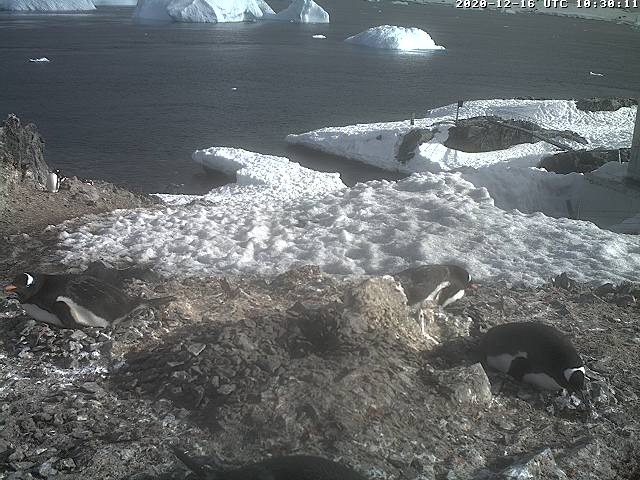
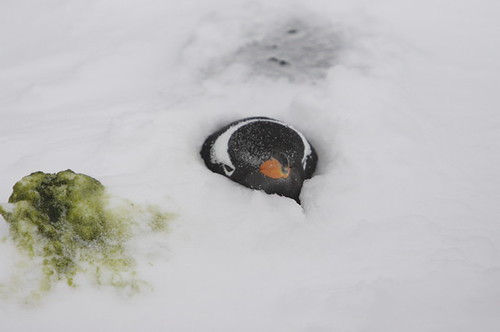
Parenting is never easy in Antarctica... as this Gentoo will attest. The egg must stay warm, despite the increase in snowfalls in the area.
It seems so long since our little friends have been here, but, the time is much shorter now for their return. We could be seeing Gentoos arrive within a month's time. Isn't that something to look forward to?
Ahay from Antarctica~~
I have begun a new blogsite with Blogger and you are all invited to come see it.
For well over a year I've been posting penguin news within the confines of MySpace. But, I realized that my readers had been limited to those folks who had memberships.
Now,on a sister site, I will present all the penguin news, as well as videos, new pix, and of course, Pencognito. So, come on over and take a looksee. The Gentoos will be arriving here before you know it and there will be so much activity to post here that it will be hard to stay current. Come now and subscribe to the posts here
Spring is coming... can't you just feel it?
wiinterrr
Okay, okay... this strip this week is one of Jen's best and if you like it, why not go say, "hey, that's great" to her at http://pencognito.com
Ready? Set... laugh!


This is a must-see!
(a special thanks to Sis and Jer for the heads up!)
Sorry that it's a bit late... but it's a must-see. Thanks to Jen at http://pencognito.com


..A gentoo penguin chick (center) is drenched by rain at Port Lockroy on the Antarctic Peninsula in January 2008. Unlike adult penguins, chicks lack water-repellent feathers and so become drenched during rainstorms. The chicks are then susceptible to freezing to death during nighttime's below-freezing temperatures.
Increasing rain in penguin habitats may be caused by global warming, making the precipitation one of many human-caused ills affecting the seabirds, a July 2008 paper says.
Photograph by Fiona Stewart via Jon Bowermaster..
Penguin Chicks Frozen by Global Warming?
John Roach
for National Geographic News
July 2, 2008
This January—deep summer in Antarctica—explorer Jon Bowermaster suffered through a five-day stretch of torrential rains on the west side of the Antarctic Peninsula. The same cannot be said for thousands of downy penguin chicks.
Epic rains are unusual in Antarctica, even in summer, said Bowermaster, who had been in the region on an expedition funded in part by the National Geographic Society's Expeditions Council.
With daytime temperatures above freezing, the rains soaked young Adélie and gentoo penguins not yet equipped with water-repellent feathers (see video below).
At night, when the mercury dipped below freezing, the wet chicks froze.
(Related: "Adelie Penguins Extinct in a Decade in Some Areas?" [December 28, 2007].)
"Many, many, many of them—thousands of them—were dying," Bowermaster said.
The experience, he added, painted a clear and grim picture of the impact of global climate change.
"It's not just melting ice," he said. "It's actually killing these cute little birds that are so popular in the movies."
The freezing of chicks is just one example of how human activity is endangering about two thirds of all penguin species, according to a new paper based on decades of research and observations.
The conservation biologist behind the paper, Dee Boersma of the University of Washington, points out some of the many ways penguins are suffering, such as by ingesting oil from spills, by being run over by tourists, by having their nesting times confused by climate change, and by losing their prey to changing currents.
She and her colleagues have watched that population decline by 22 percent since 1987, with the biggest drop coming in 1991 after a major oil spill. The colony has also lost members to fishing nets, starvation linked to overfishing, and shifting ocean currents that force penguins to swim farther from their nests to feed.
Penguins are going about 60 kilometers [37 miles] farther to find food than they did a decade ago," she writes in the paper, published today in the journal BioScience.
Global Warming
Increasing temperatures are also affecting breeding populations in Antarctica by breaking up ice, changing precipitation patterns, and altering nesting times, Boersma writes.
In 2006 she visited the seasonal sea-ice home of the penguin colony featured in the 2005 movie March of the Penguins. The region was uncharacteristically ice free.
Apparently sensing danger, the penguins had marched the colony several miles farther inland to more protected ice. A windstorm a few weeks later broke up the ice, forcing the birds into the water.
While the adults could survive, the young chicks had yet to fully develop and most likely all died, Boersma notes.
In the Galápagos Islands a penguin population is down to just 2,500 birds from the nearly 10,000 that were there when Boersma first studied the birds in the 1970s.
More frequent El Niño weather patterns—believed to be a consequence of climate change—are pushing penguin prey further out to sea, which is causing the Galápagos seabirds to starve, she noted.
On South African islands, where penguins burrow into mound of seabird droppings to make nests, humans harvesting the guano for fertilizer contributed to a penguin population decline from 1.5 million a century ago to 63,000 breeding pairs today.
Even tourists, Boersma said, can wreak havoc on penguins. At Punta Tombo, Argentina, for example, vehicles ran over five penguins in January 2007.
"The visitors who flock to Punta Tombo are loving the penguins to death," she wrote.
Poster Species?
Boersma would rather see humans' affection for penguins focused into efforts to improve the birds' marine environments.
"If people really know that we're having this kind of effect on penguins, we might change how we do business," she said.
But Boersma isn't just interested in raising awareness.
She advocates the creation of an international institution that regularly monitors penguins to gain insight into changes in the ocean food chain and long-term climate variation. Such an effort would make the seabirds "marine sentinels," she said.
"If we can understand more about them, we presumably could reduce the problems that penguins and other species are having—and maybe save ourselves," she said.
The idea of using penguins as a poster species is not novel, according to David Ainley, an ecologist and penguin expert with ecological consulting firm H.T. Harvey & Associates in San Jose, California.
For example, Ainley noted the California-based Center for Biological Diversity petitioned the U.S. government in 2006 to list ten penguin species under the Endangered Species Act.
"Because penguins are so well known, [the center's] agenda was to use them as a kind of handle to increase awareness of climate change," he said.
Ainley said Boersma makes a "nice" case that penguins could serve as useful, attractive environmental monitors. In fact, several Antarctic penguin species are already monitored under the Antarctic Treaty System—a series of agreements among states operating on the continent—he noted.
Bowermaster, the explorer and writer, said any studies that highlight changes in the marine environment, especially those in Antarctica due to global climate change, are valuable.
"If you can use penguins to that end," he said, "I would say great."


Please visit Jen at http://pencognito.com and say hi to the all the penguins!

.jpg)